
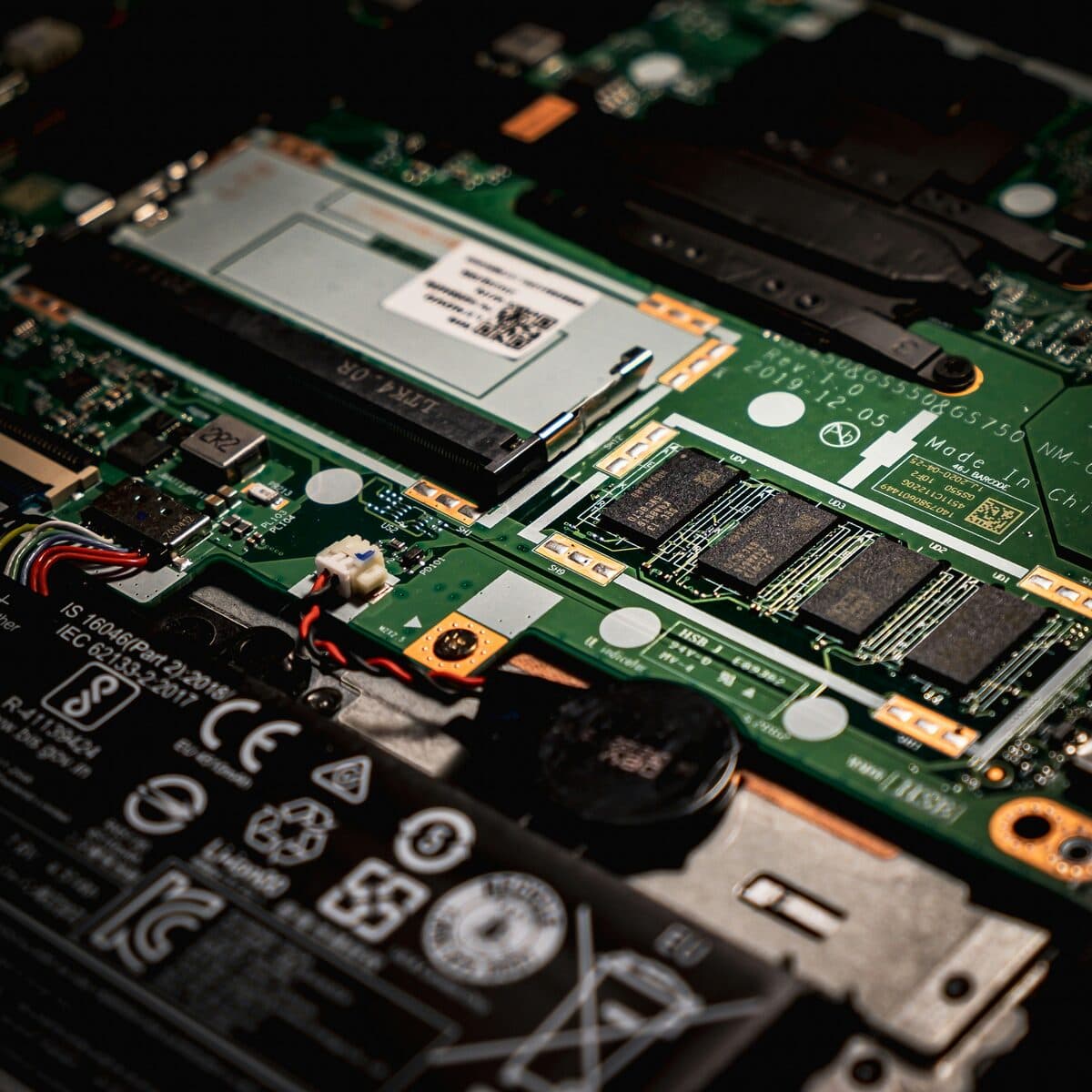
M.2 2280 vs M.2 2242
The M.2 standard defines the physical dimensions of modern SSD modules used in computers, servers and embedded systems. The designation combines width and length in millimeters: the M.2 2280 measures 22mm wide by 80mm long, the M.2 2242 measures 22mm wide by 42mm long.
Physical size and industrial integration
M.2 2280 (22 × 80mm) is the standard format for industrial workstations and high-performance servers, where space allows for a longer module. Its larger footprint accommodates more advanced thermal-management circuitry, which maintains reliability over an extended operational lifespan.
M.2 2242 (22 × 42mm) is the compact option for embedded industrial systems, robotics, instrumentation and equipment with severe space constraints. The smaller format limits mechanical imbalance risk and eases integration into confined enclosures.
Resistance to harsh environments
Industrial M.2 SSDs include specific quality controls and protections:
- Thermal tolerance — industrial variants support operating temperatures from -40°C to +85°C, up to +95°C on premium models
- Thermal management — the 2280 benefits from better passive dissipation thanks to its larger surface area; the 2242 often includes additional heatsinks or mounts on actively cooled boards
- Shock and vibration resistance — both formats comply with the MIL-STD-810G military standard, rated for up to 1500G shock and 20G vibration across three axes
- Environmental protection — equivalent moisture, dust and EMI shielding on both formats
Industrial performance
The industrial M.2 2280 variant typically supports PCIe Gen4×4 or Gen5×4 connections, delivering maximum throughput exceeding 7000 MB/s for demanding applications like machine vision and embedded AI.
The industrial M.2 2242 variant may be limited to PCIe Gen3 or Gen4×2, reaching up to 3500 MB/s — enough for many embedded applications, balancing performance against power consumption.
Both formats run advanced industrial firmware with full wear leveling, bad-block management, auto-refresh, and specialized protections, delivering durability typically ten times that of consumer versions.
Industrial capacities
- Industrial M.2 2280 — available from 128GB to 4TB, suited to large industrial databases and storage-intensive applications
- Industrial M.2 2242 — maximum capacity around 1TB due to physical space constraints, suited to embedded systems and industrial IoT
Compatibility and system integration
M.2 2280 modules are compatible with most industrial motherboard M.2 slots, though their size can pose a problem in confined racks or restricted enclosures.
The 2242 format offers more flexibility for integration into custom industrial boards, particularly where limited length is strategically important for compactness and mechanical resilience.
Selection should also factor in the available PCIe or SATA connections and NVMe protocol support on the target system.
Conclusion
For industrial applications, the M.2 2280 is the optimal choice for combining high performance, substantial capacity and effective thermal management in medium-to-large systems. The M.2 2242 offers an excellent compromise when compactness and mechanical ruggedness take priority, without sacrificing endurance or reliability. Selection should be driven by mechanical constraints, temperature requirements, required throughput and capacity for the specific industrial application.